Mathematics Education

Dr. Courtney Nagle
Executive Vice President, Learning Research & Design
Supporting Mathematical Problem Solving
Published
Last updated

Responses to a Real-World Problem
Imagine that it is 2 a.m. You are suddenly awakened by the sound of your smoke detector going off. What do you do?


Response 1:
Decision-Making without Sense-Making
You quickly jump out of bed, grab a broom from a nearby closet, and hit the smoke detector until it stops beeping. With the problem “solved”, you go back to sleep. You never ask why the smoke detector was beeping in the first place. You act without thinking about the underlying problem. You took action through decision-making. The smoke detector has stopped beeping. But has the problem been solved?

Response 2:
Sense-Making without Decision-Making
You hear the noise and take a moment to process what is going on. You think to yourself, “the smoke detector is signaling that there could be smoke in the house, and that could potentially indicate danger.” Having made sense of the situation, you then wait to see if the fire department shows up. You convince yourself that the fire fighters are the experts in these situations, so there is no reason to act. You crawl back into bed and wait for the firefighters to decide what steps to take next. You have made sense of the situation and have reasonable insights. But you stop short of making decisions about how to proceed. Has the problem been solved?

Response 3:
Decision-Making Disconnected from Sense-Making
You hear the noise and process the possibility of real danger if the noise is an indicator of smoke detected in the house. You decide to take action. But rather than examining the house for smoke, you recall that you successfully stopped the smoke detector from making noise before by changing the batteries. Although you know the batteries in the detector are new and recognize the sound as different than what you’ve heard before, you still return to your familiar strategy to remedy the solution. You made sense of the situation. And you made a decision for how to respond. But has the problem been solved?
Of course, none of these responses to being awakened in the middle of the night by your smoke detector is an ideal response. And none of them solves the problem if indeed there is a fire in the house. You might be thinking the responses are silly, and that no one would ever respond this way in real life. But what if we switch the context to mathematical problem solving? These three responses are actually quite common when students engage in mathematical problem solving.
Responses to a Mathematical Problem
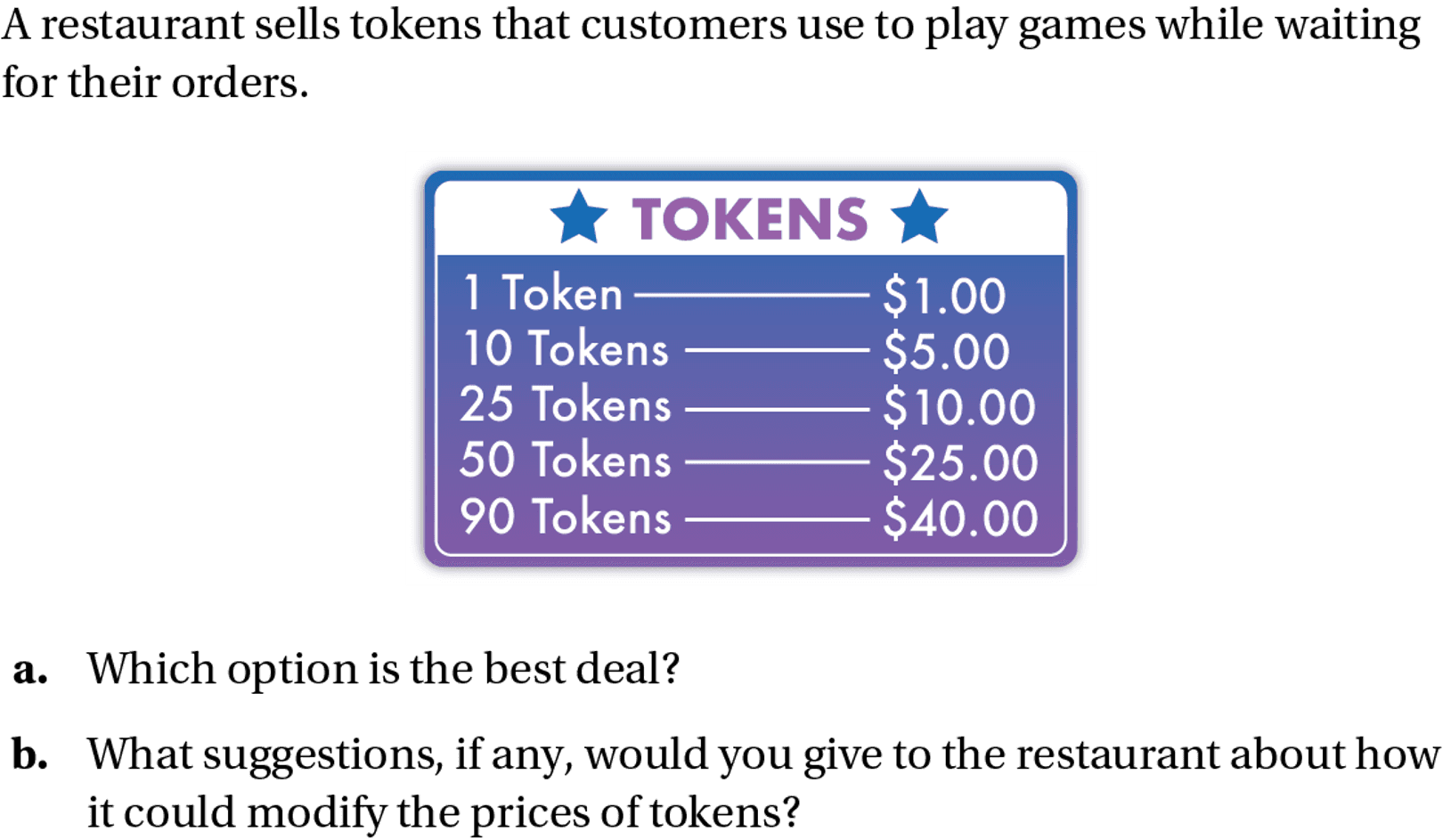
Consider the 6th grade mathematics task as an example.
Why choose this task?
Before we dive into how students respond to this task, let’s take a moment to consider the task itself. Why would a teacher choose to implement this task with students?
The task is a high-cognitive demand task. According to the Task Classification Framework, the task classifies as a high-cognitive demand task because there is no set pathway for solving the task, students have to think meaningfully about the strategy they use to interpret what the results mean relative to the “best deal”, and students have to synthesize their thinking to make pricing recommendations for the restaurant.
The task provides an opportunity for students to engage in the first Standard for Mathematical Practice, make sense of problems and persevere in solving them.
Using this task during instruction aligns with the instructional practices described in NCTM’s effective mathematics teaching practices, namely implement tasks that promote reasoning and problem solving.
So, this task is a good choice from a variety of lenses. But what happens when students engage with the task during a lesson? Let’s step into a hypothetical classroom and take note of some common student responses. Do you recognize any of these students from your own classroom?

Meet Marcus
I know a formula to use to find the answer.
As soon as Marcus sees the task displayed on the projector, he begins writing. He barely glances at the context before deciding that this is a division problem. Using the prices and token quantities, he starts calculating ratios, confident that he knows what to do. When a classmate asks how he decides on that approach, Marcus replies, “You always divide when you see a table like this.” He works quickly and efficiently, producing several calculations before many of his classmates have even begun.
When the teacher asks students to explain what best deal means in this situation, Marcus pauses. He can point to his calculations, but he has spent little time thinking about what the numbers represent or why comparing them makes sense. He hasn’t considered whether he is dividing the number of tokens by total cost or whether he is dividing total cost by the number of tokens. Later, when students are asked to recommend changes to the restaurant’s pricing structure, Marcus becomes less confident. There is no obvious procedure to follow, and the task requires interpretation rather than computation alone.
Marcus engaged in decision-making without sense-making.

Meet Jamal
What should I do first?
Jamal studies the token-pricing task carefully. He notices that some packages seem like better deals than others and immediately begins thinking about possible ways to compare them. He considers creating a graph, calculating the cost per token, or looking for patterns in the pricing structure. Although several productive ideas come to mind, he hesitates to commit to any of them. Instead, he raises his hand and asks, “What am I supposed to do first?” When the teacher encourages him to choose an entry point himself, Jamal pauses and looks back at the task, hoping for additional guidance. He waits quietly until the teacher goes over the task, waiting to see what strategy the teacher uses to tackle the problem.
Jamal’s challenge is not a lack of understanding. He is able to make sense of the mathematics and often identifies reasonable ways to approach a problem. What he struggles with is deciding which path to pursue.
Jamal engages in sense-making without decision-making.

Meet Elena
Maybe I should do it the way they did it.
Elena approaches the token-pricing task differently from many of her classmates. Rather than immediately calculating unit rates, she begins looking for patterns in the prices. She begins looking for an effective way to compare the price across the options and decides to determine the cost of 450 tokens under each scenario. She recognizes that 450 tokens will cost $180 if a customer purchases 25 tokens at a time but will cost $200 if a customer purchases 90 tokens at a time. This leads her to make meaningful suggestions for changing the pricing structure to encourage customers to purchase more tokens at the outset.
As students begin discussing their work, Elena overhears several classmates talking about unit rates. She quietly looks back at her own paper and begins to second-guess herself. “Maybe I’m supposed to do it that way,” she says to herself. Although the reasoning she used is mathematically sound, Elena spends much of her energy looking for evidence that she might be wrong. She becomes preoccupied with whether her approach matches those of her classmates. Eventually, she erases all the great thinking she has done and completes the problem using the unit rate strategy her classmates used instead.
Elena engages in decision-making disconnected from sense-making.
Persistent Problem Solvers
MP.1 Make sense of problems and persevere in solving them
These common student responses remind us that engaging students in problem solving is often more complex than simply presenting worthwhile tasks. Providing opportunities for problem solving does not guarantee that students will engage meaningfully in those tasks or persevere in solving them. Supporting students in developing proficiency with MP.1 requires us to unpack several important ideas. While sense-making is a critical component of problem solving, it alone does not ensure perseverance. We must also consider the role of decision-making, and, more importantly, whether those decisions are grounded in students’ understanding of the problem. By examining the interplay between sense-making and decision-making, we can better understand what it takes to support students as confident and persistent problem solvers.
The Role of Sense-Making
As explicitly stated by SMP.1, it is important that students begin by making sense of the problem they are solving. Sense-making requires that students understand what relationships are present, what quantities represent, what information is known, and what questions remain to be answered. Without first engaging in sense-making, students will rely on familiar strategies and rote procedures. Without sense-making, students will struggle when it comes to interpreting the meaning of their solutions, as we saw with Marcus when it came time to make a pricing recommendation to the restaurant. Sense-making is a necessary starting point for problem solving to occur.
The Role of Decision-Making
But Jamal reminded us that sense-making is not enough. Students also must become mathematical decision-makers. As teachers, it can be tempting to swoop in and rescue students at this point of problem-solving. They’ve made sense of the problem, they’ve asked great questions, they’ve unpacked what they need to find. But now they need to commit to a pathway to finding those answers. Many students have learned that school mathematics is about solving problems in the way that the teacher wants you to proceed. So, they hesitate when making decisions. But choosing how to solve a problem is a critical step of persevering in solving problems. And we need to allow students to make those decisions, even if it leads them to use a less efficient or somewhat unorthodox strategy.
The Connections Between Sense-Making and Decision-Making
And finally, we need to ensure that students are supported in decision-making that is grounded in their sense-making. Elena reminded us that students in mathematics classes often doubt their own reasoning when making decisions. Even though a student has engaged in sense-making, they may be quick to turn away from that reasoning when making decisions about how to proceed. Students tend to doubt their own mathematical reasoning in favor of making decisions that align with the teacher or their peers, who they perceive as more likely to be correct than they are.
Student Look-Fors and Teacher Moves
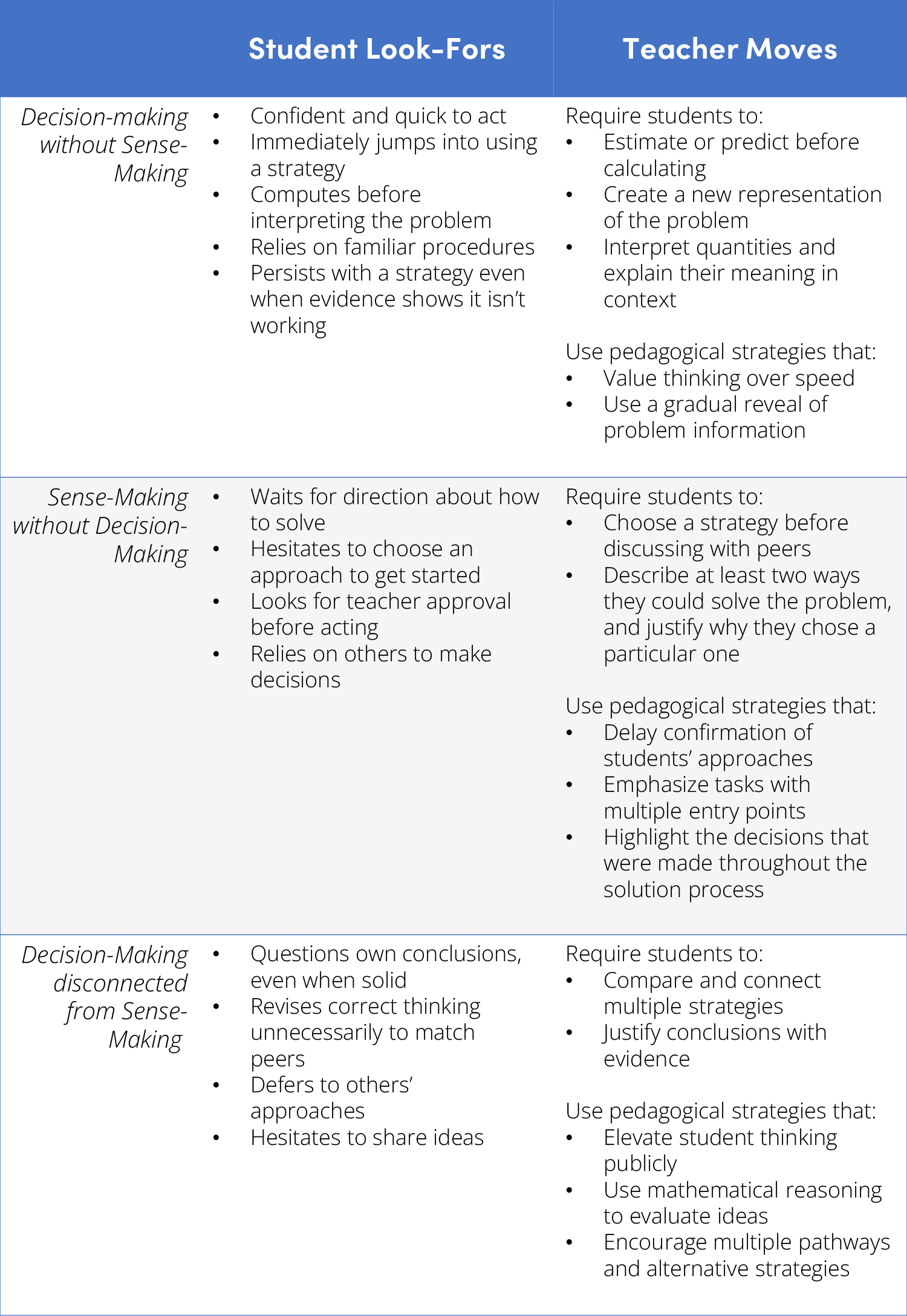
So, how might we support students in fully engaging in problem solving? As students work through rich mathematics tasks, we can keep our eyes open for common behaviors that suggest they may be engaging in decision-making without sense-making, sense-making without decision-making, or decision-making disconnected from sense-making. Then, we can respond in ways that emphasize the components they are missing.
Reflection
Problem solving requires sense-making, decision-making, and meaningful connections between the two in order to produce solutions that are both mathematically sound and personally meaningful. As you reflect on your own students, where do they need the most support? Which of the strategies discussed here might help them make sense of problems, make purposeful decisions, and persevere when the path forward is unclear?
Over time, these experiences do more than improve students’ problem-solving skills. They shape how students see themselves as mathematicians. When students consistently engage in sense-making and decision-making, they begin to develop something even more powerful: the understanding to make informed choices, the agency to act on their ideas, and the confidence to trust and justify their reasoning. These capacities are at the heart of mathematical empowerment.
Meet the Expert

Dr. Courtney Nagle is the Executive Vice President of Learning Research & Design at Big Ideas Learning. With more than two decades of experience in mathematics education, her work centers on bridging research and classroom practice to improve mathematics teaching and learning.
Dr. Nagle’s career reflects a dual commitment to teaching and research. She spent twenty years teaching mathematics and mathematics education courses at the undergraduate level at Penn State Behrend in Erie, PA. Her teaching excellence has been recognized with the 2022 Penn State University Eisenhower Award for Distinguished Teaching and the 2018 MAA Allegheny Mountain Section Award for Distinguished College or University Teaching of Mathematics. In addition to her teaching accomplishments, Dr. Nagle has established a strong record of scholarly research, serving as Principal Investigator or Co-Principal Investigator on four National Science Foundation-funded projects totaling nearly $2.5 million and has published in leading journals including Educational Studies in Mathematics, The Journal of Mathematical Behavior, The International Journal of Science and Mathematics Education, and The Mathematics Teacher.
At Big Ideas Learning, Dr. Nagle leads the Learning Research & Design team in defining a research-based vision for mathematics teaching and learning and partnering across the organization to bring that vision to life through high-quality instructional materials.