Teaching Strategies

Damon Finazzo
Vice President of Learning Research & Design
The Teacher-Student Relationship: How Opportunity and Instruction Shape Learning
Published
Last updated
In our first post, we talked about the six relationships that are key to paving a pathway for educating a future-ready generation:
Teacher ↔ Student
Teacher ↔ Teacher
Teacher/School ↔Family
Student ↔ Student
Curriculum ↔ Student
Student ↔ Community
As we dive deeper into each of these six relationships, one thread runs through nearly all of them: Productive Disposition, or Confident Engagement. This strand, one of the five Strands of Mathematical Proficiency, may be one of the most important factors in improving student mathematics learning, and it’s within the student-to-teacher relationship that it takes root. Whether students come to believe that they can learn, feel safe to try, and see math as meaningful depends significantly on this relationship.
The Teacher-to-Student Relationship
In the Teacher-to-Student relationship, I propose that we bring our attention to two topics:
opportunity and environment
teaching strategies
Teaching strategies used within the classroom are most commonly linked to the classroom environment, but student survey data points to another, less obvious factor: the opportunities students are given by their teachers and schools. Those opportunities may shape the environment just as much as any instructional choice. Take these survey results collected by YouthTruth from over 90,000 high school students in 2023. Only 46% of students surveyed reported feeling comfortable asking questions in math class. A full 26% said they rarely or never speak up when they need help. Our first instinct may be to attribute this to teacher strategies and the classroom environment, but diving deeper into these survey results, we start to notice an additional factor that may contribute to these numbers.
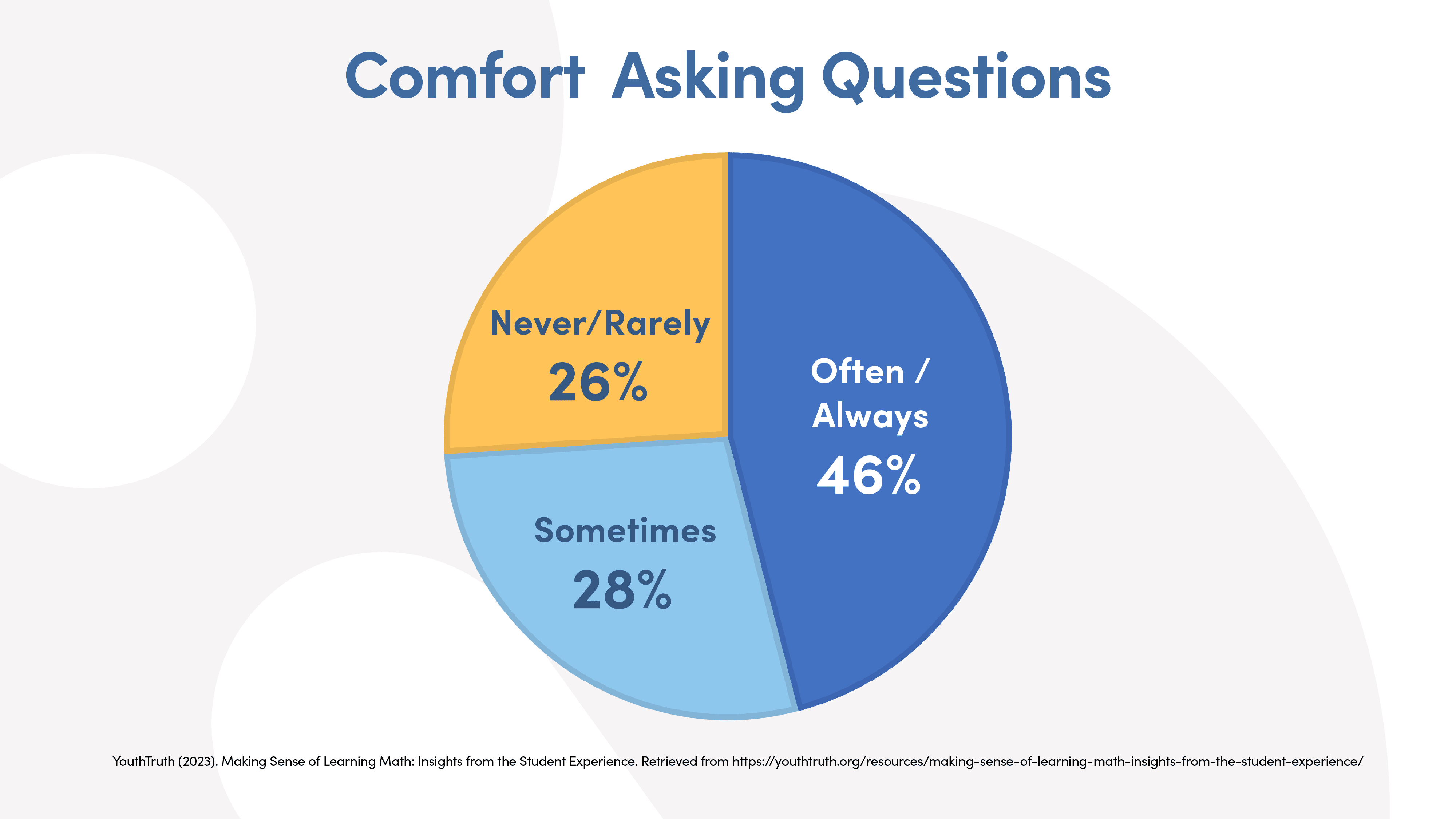
When breaking down that 46% of students who felt comfortable to ask questions, the following categories all reported feeling comfortable asking questions at rates above the overall average:
White students – 50%.
Boys – 51%.
Students with parents/caregivers holding bachelor’s degrees – 52%.
Students with parents/caregivers holding advanced degrees – 55%.
That data might not be surprising, but this fifth category is what should grab our attention.Students who took Algebra 1 in Grade 8 – 52%.
This fifth category generates more questions to contemplate.
Could it be that teachers who are teaching students who qualify for Algebra 1 in Grade 8 provide a different environment than teachers who are teaching general math to students in Grade 8?
Could it be that the expectations of the learner, the approach of the teacher, and the perspective of the student (their perceived value as a learner) are higher/better because of the opportunity that the teachers and students are getting in this learning environment?
Could it be that students feel more comfortable asking questions in a classroom where they are given the best opportunity to maximize their potential as a learner?
To try and answer these questions, we find even more interesting information as we dig deeper into the data. Only 40% of Hispanic/Latino students said that they always felt comfortable asking questions in class. Again, on the face of it, the data seems to speak to the environment created between the teacher and the student. However, when coupling this data with a study from Stevens, Hamman, and Oliv’arez, Jr. in 2007 (“Hispanic students’ perception of white teachers’ mastery goal orientation influences sense of school belonging” – Journal of Latinos and Education, 6, 55-70.), we are hard pressed to not return to the premise that perhaps opportunity helps drive the environment, instead of the other way around.
The Stevens study tells us that, “…the more teachers promoted learning over performance (challenging students, encouraging ideas, requesting they explain their work), the more students felt like they belonged to their school.”
This data suggests that classrooms that use the highest impact teaching strategies to provide the highest level of learning opportunities to students foster stronger teacher-student relationships.
When teachers create high-opportunity environments, the results compound, fostering up to two years of learning growth and a higher level of student comfort and belonging in the classroom. John Hattie’s research on High Impact Teaching Strategies highlights the importance of focusing our energies on the most impactful things that teachers can incorporate into their relationships with their students.
High Impact Teaching Strategies
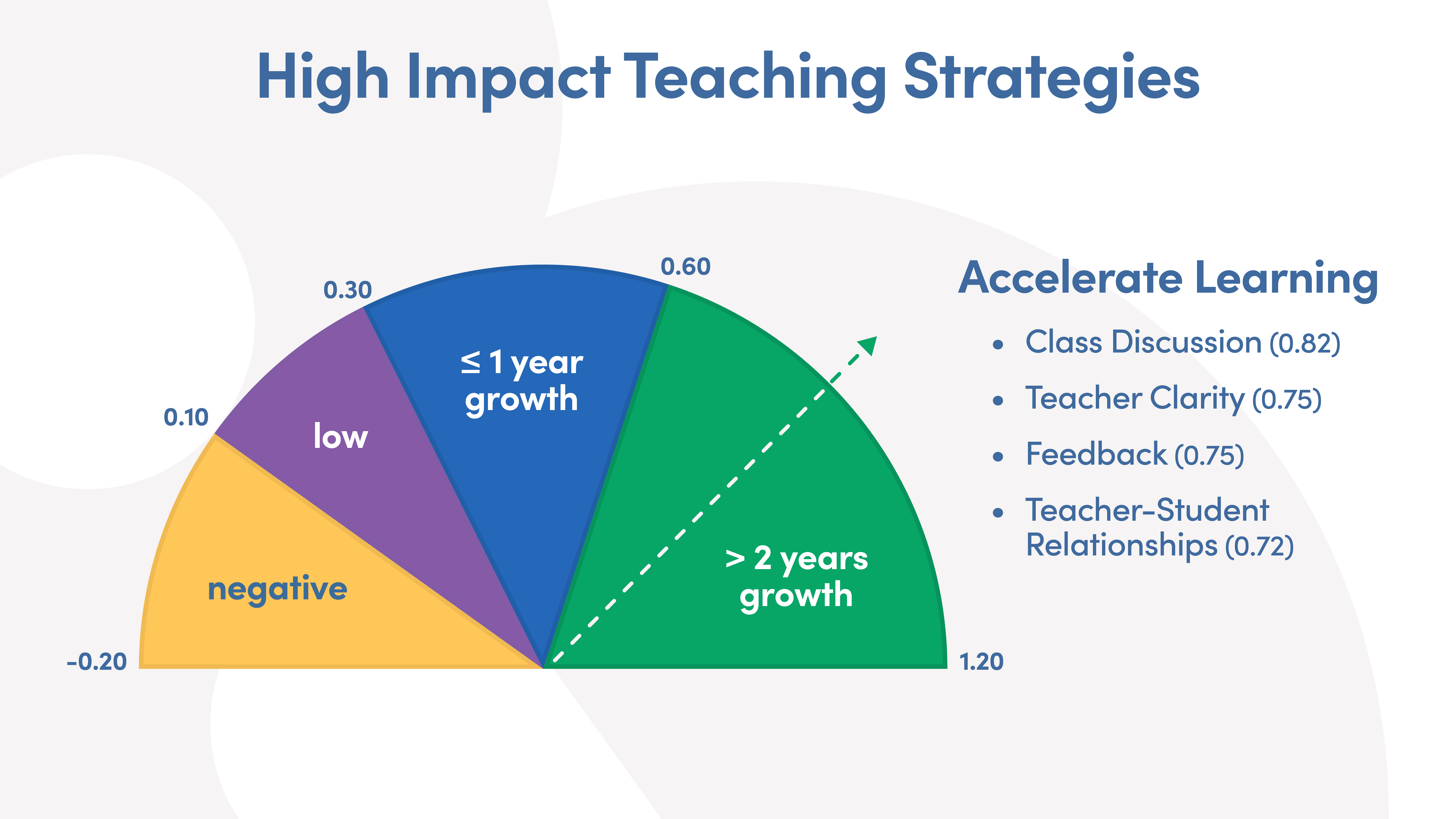
Let’s look at four of the essential teaching strategies: Teacher Clarity, Class Discussion, Feedback, and Teacher-Student Relationships). These strategies directly reflect on the teacher-student relationship. Even more importantly, these four teaching strategies fall into the highest impact segment of Hattie’s research, meaning that they all can help student learning accelerate potentially up to 2 years of growth. Over the 260 different instructional strategies, ideas, and tools that Hattie researched, all four of these strategies fall in the top 12 and should grab the attention of any teacher and/or teacher leader who is looking to maximize the teacher-student relationship and the student learning in their classrooms.
Teaching Strategies
Teacher Clarity
#9 – 0.75 effect size
Class Discussion
#7 – 0.82 effect size
Feedback
#10 – 0.75 effect size
Teacher-Student Relationships
#12 – 0.72 effect size
The claim could be made that classrooms that incorporate these high impact strategies (as Hattie describes them in Visible Learning for Mathematics) often have positive environments. Yet one must wonder if the opportunity provided to the students by the teacher is what truly drives the ability to fully implement these teaching strategies and sustain the positive classroom environments as a result.
The teacher-student relationship, then, is not only about technique. It’s also about the message a teacher sends to a student through the opportunities offered to the student, and whether the student comes to believe, because of those opportunities, that mathematics is something they’re capable of doing and worth the effort to learn.
In the next post in this series, we’ll shift from individual classrooms to the collective impact of teachers working together, exploring how teacher-to-teacher relationships and shared beliefs can dramatically influence student learning outcomes.
Meet the Expert

Damon Finazzo, M.Ed. is the Vice President of Learning Research & Design at Big Ideas Learning and is an education leader who has served in a variety of roles over the past 24 years, some of which include elementary school teacher, PreK-8 principal, and president of a PreK-8 Catholic school system.
He holds instructional (K-6) and administrative (N-12) credentials from the Virginia and Pennsylvania Departments of Education, and a Master’s of Education in School Leadership and Supervision (N-12) from Virginia Commonwealth University.
Damon’s experiences in working in PK-12 schools and educational publishing for PK-16 mathematics has proven him to be a collaborative, thoughtful, and compassionate leader focused on teachers, students, and community with an educational philosophy grounded in three fundamental principles: belief, motivation, and service.
References
Stevens,T.,Hamman,D.,&Oliv´arez Jr., A. (2007). Hispanic students’ perception of white teachers’ mastery goal orientation influences sense of school belonging. Journal of Latinos and Education, 6, 55–70. doi:10.1080/15348430709336677
Visible Learning For Mathematics, Grades K-12. Hattie, Fisher, Frey, ©2017 by Corwin.
YouthTruth (2023). Making Sense of Learning Math: Insights from the Student Experience. Retrieved from https://youthtruth.org/resources/making-sense-of-learning-math-insights-from-the-student-experience/