Teaching Strategies

Damon Finazzo
Vice President of Learning Research & Design
The Teacher-Teacher Relationship: How Collective Efficacy Drives Student Achievement
Published
Last updated
In our last article, we explored the Teacher-to-Student relationship. This discussion around teachers providing the best opportunities possible for their students and the High Impact Teaching Strategies that make these opportunities effective leads perfectly into the second key relationship in educating a future-ready generation: Teacher-to-Teacher. According to Hattie’s meta-analysis research, getting this relationship correct is the single most effective way to positively impact student learning.
Building Effective Teacher-to-Teacher Relationships
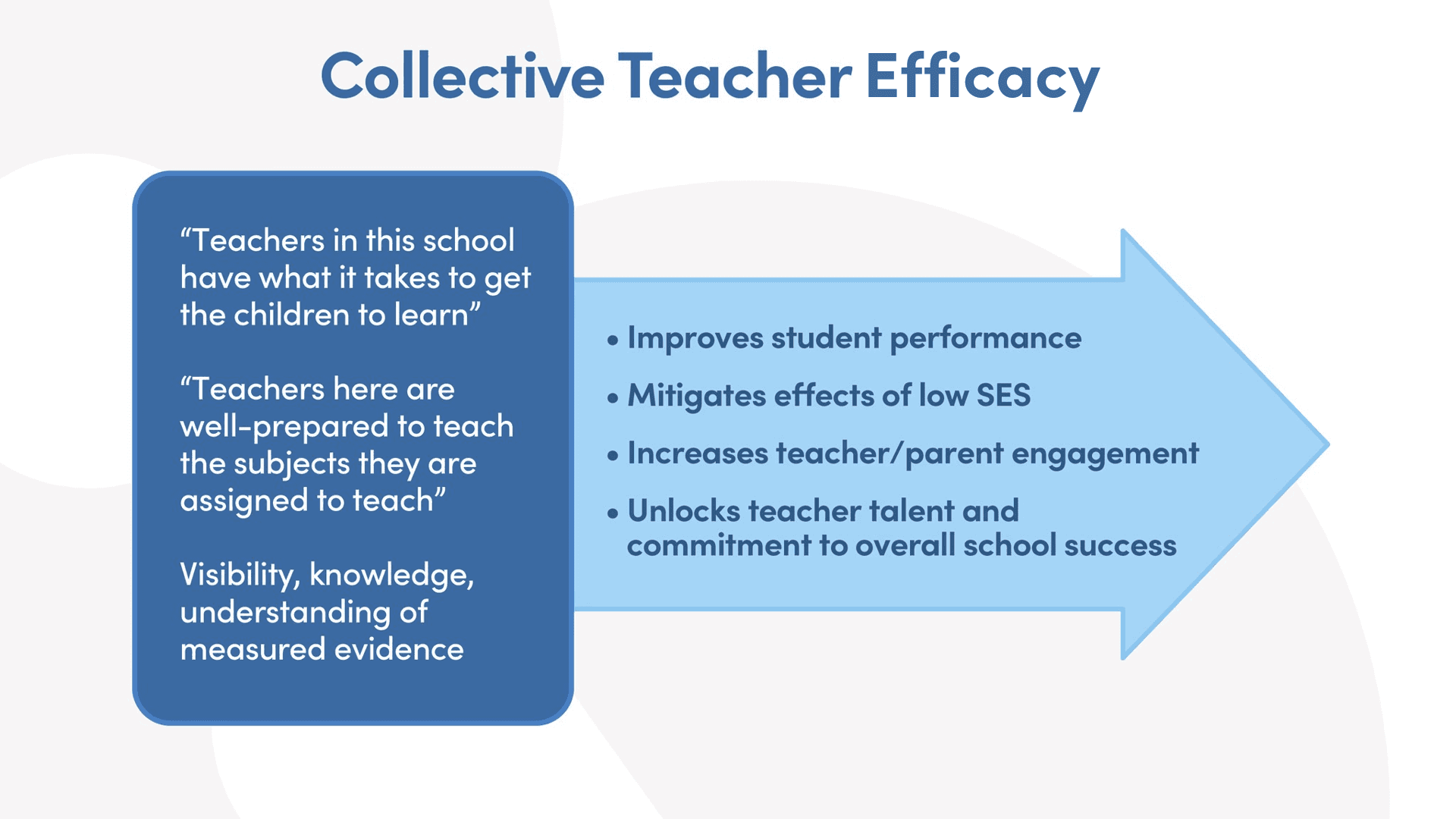
The Teacher-to-Teacher relationship is not just about whether teachers get along or respect one another professionally. Instead, this relationship is most effective when three things come together simultaneously:
Teachers have a collective belief that all students can learn at the highest level
Teachers hold one another accountable to #1
Teachers supply one another with evidence of the positive impact their beliefs, expectations, and teaching strategies are continually having on student achievement
This is more than a shared positive mindset about students. When teachers actively hold one another accountable and consistently provide evidence of impact to one another, the research suggests something striking: outside forces like low socioeconomic status, low parental involvement, and teacher burnout are mitigated and, in some cases, eliminated.
Research around this type of efficacy started in the 1970s when Albert Bandura first introduced this concept as “collective efficacy.” Thanks to many researchers after him (like Roger Goddard, Wayne Hoy, Anita Wollfolk Hoy, Dr. Rachel Jean Eells, and Professor John Hattie) understanding of the concept has grown and it is now more widely identified as Collective Teacher Efficacy (CTE) in the education field. (Donohoo, J., Hattie, J., & Eells, R. (2018)).
From the 1970s through the early 2000s, CTE was studied in schools, with study after study rendering more data points to be considered as to what worked best and what did not work well. Then, in 2011, Dr. Eells looked at many of these studies in a meta-analysis of CTE’s relation to student achievement and concluded that there is a strong association between student achievement and the beliefs that teachers hold about the achievement ability of the school as a whole.
The Impact of Collective Teacher Efficacy (CTE)
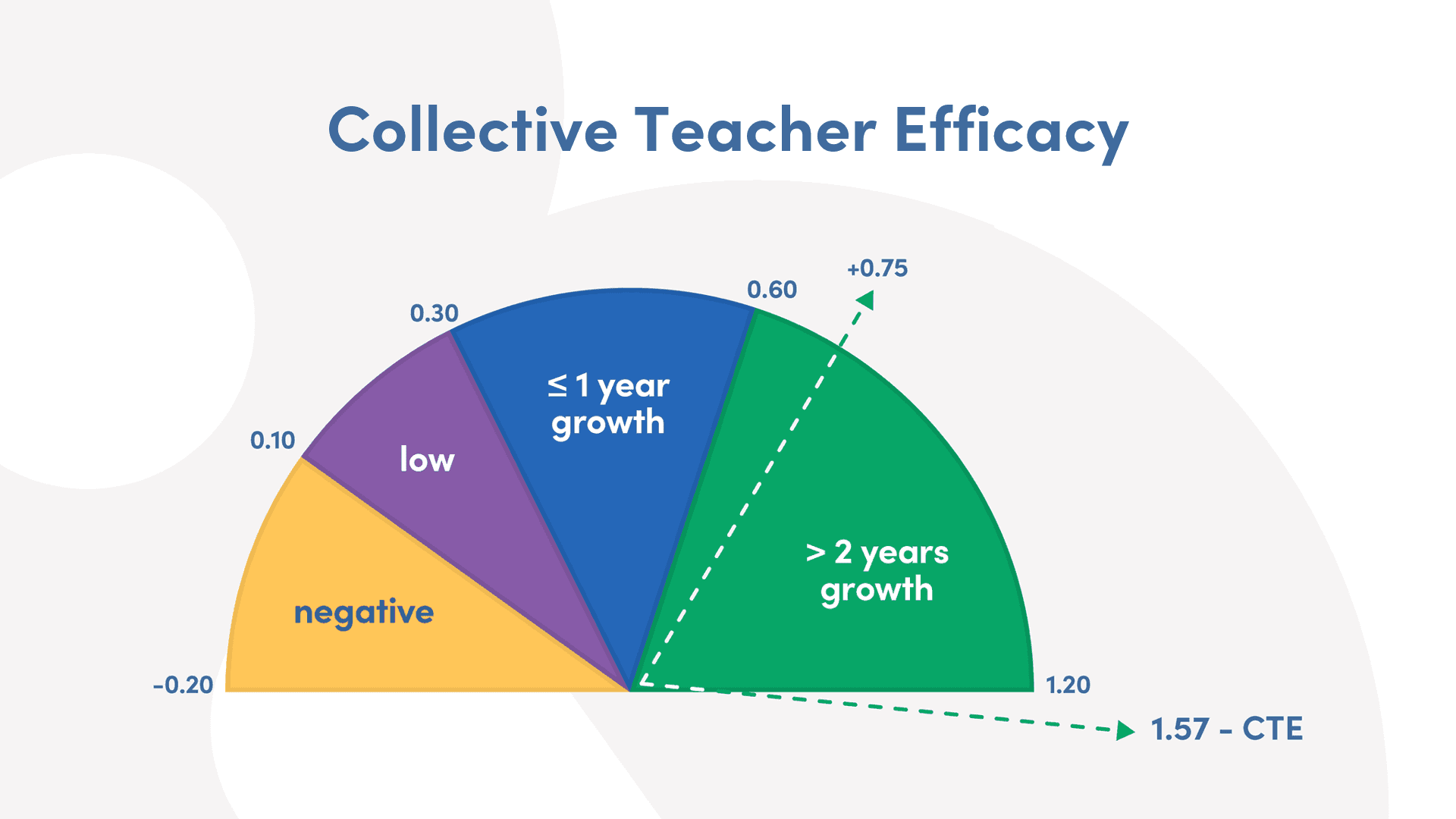
It was Eells’ meta-analysis and organization of the data that grabbed the attention of Professor John Hattie. Through studying her meta-analysis, he found that out of hundreds of other strategies and approaches considered, CTE was the single most effective strategy to positively impact student achievement. His research claims that when CTE is implemented correctly, it is possible for students to have greater than two-years of growth in one year of school.
To put this into perspective (see the chart below), CTE has a positive effect size of 1.57, while the four high impact teaching strategies that we covered under the Teacher-to-Student relationship have an average of about 0.75. This means that CTE is over twice as effective as those high impact teaching strategies. That is a significant claim, and one that every educator should pay close attention to and consider carefully.
To extend the notion of CTE’s impact on student learning, I purport that teachers who correctly implement CTE will naturally incorporate the four high impact teaching strategies we discussed previously into their day-to-day classroom instruction. Teachers who believe their students can learn, who hold one another accountable to ensure that everyone believes that their students can learn, and who continually measure and share the evidence of what works (and does not work) to help students learn, are the same teachers who embrace and master classroom discussion, teacher clarity, feedback, and strong teacher-to-student relationships.
It bears repeating if teachers haven’t heard this before: Teachers are the single most important influence in the success of a student’s learning journey. The sooner individual teachers acknowledge this great responsibility and commit to collectively work together to support one another in becoming the best versions of themselves for the sake of their students, the sooner our education system will effectively prepare future-ready generations.
In our next post, we’ll examine the teacher- and school-to-family relationship and how trust, transparency, and perceived value influence family engagement and student learning, particularly as this relationship becomes more difficult at the secondary level.
Meet the Expert

Damon Finazzo, M.Ed. is the Vice President of Learning Research & Design at Big Ideas Learning and is an education leader who has served in a variety of roles over the past 24 years, some of which include elementary school teacher, PreK-8 principal, and president of a PreK-8 Catholic school system.
He holds instructional (K-6) and administrative (N-12) credentials from the Virginia and Pennsylvania Departments of Education, and a Master’s of Education in School Leadership and Supervision (N-12) from Virginia Commonwealth University.
Damon’s experiences in working in PK-12 schools and educational publishing for PK-16 mathematics has proven him to be a collaborative, thoughtful, and compassionate leader focused on teachers, students, and community with an educational philosophy grounded in three fundamental principles: belief, motivation, and service.
References
Brinson, D., Steiner, L. (2007). Building Collective Efficacy: How Leaders Inspire Teachers to Achieve. The Center for Comprehensive School Reform and Improvement, Issue Brief, October 2007, 1-6. www.centerforcsri.org
Donohoo, J., Hattie, J., & Eells, R. (2018). The power of collective efficacy. Educational Leadership, 75(6), 40–44. http://www.ascd.org/publications/educational-leadership/mar18/vol75/num06/The-Power-of-CollectiveEfficacy.aspx
Josselson, R. (1992). The space between us. San Francisco, CA: Jossy-Bass.
Visible Learning For Mathematics, Grades K-12. Hattie, Fisher, Frey, ©2017 by Corwin.