Teaching Strategies

Damon Finazzo
Vice President of Learning Research & Design
The School-Family Relationship: How Trust and Transparency Support Student Learning
Published
Last updated
Now that we have explored the Teacher-to-Student and Teacher-to-Teacher relationships, let’s examine the Teacher/School-to-Family relationship.
Families of elementary students ultimately look for their children to come home after school and tell stories of how the social and academic behaviors reinforced at school are the same ones that are expected to be displayed at home. Naturally, in these situations the Teacher/School-to-Family relationship is strong. Where there is a perception from the family that the school is not reinforcing the same expectations at school as is expected at home, the relationship becomes tenuous and difficult.
As children grow and move into middle school, families begin to decrease the level of day-to-day involvement in what happens at school. This can begin to relieve some pressure on the school and family always being in lockstep; however, it also increases the difficulty of getting teachers and families working together to support each student as naturally as what was done in elementary school.
In high school settings, the Teacher/School-to-Family relationship can be even more difficult in comparison to elementary and middle school settings. At the high school level, parents and guardians tend to lean heavily on the responsibility of the student to manage what is going on in school—communicating with teachers, grades, and day-to-day learning. It is important for students to become more personally responsible for their education. In addition to the natural independence of students that occurs at the high school level, there also tends to be some previous experiences that prevent parents/guardians from engaging with high school teachers and curriculum. Not every adult has had positive high school experiences, so they may not trust the teacher or school, or not trust themselves with the higher-level curriculum that is being taught in high school.
Improving the School-Family Relationship through Transparency and Building Perceived Value
Two powerful approaches that improve the school-family relationship are transparency and building perceived value. When a teacher/school is transparent, open, vulnerable, and honest with the families of their students, the families can start to trust that the teacher and school are acting as an extension of the home. This is what most parents/guardians are looking for—school being an extension of the values, principles, and goals of the home.
Once the trust of the family has been established, the teacher/school is more likely to convince the parent/guardian of the value of supporting their child and engaging with the teacher/school. High schools can fill gymnasiums and stadiums for student athletic performances, or theaters and auditoriums for artistic performances. Can we learn anything from those events that would inform us about how to increase the perceived value by the family in the academic endeavors of the student? We could begin by collaborating with the students (who know their families the best) to come up with ways to get the parents/guardians to be more engaged and involved at the school. Students know what interests their families and what they value, so the teacher/school can leverage those interests and values in their parent/guardian collaboration.
Every school system and community has a different culture and value system, and it’s important for teachers/schools to tap into those systems to increase family involvement in the education of our children. For example, I have seen student-led parent-teacher conferences build family engagement, because the student not only invited the family to the conference, but the student also put together educational artifacts to showcase the educational progress being made by them in the classroom. Another example that is becoming increasingly popular is the use of smartphone applications. Teachers empower the student to utilize a school-based or classroom-based app to engage the family through posts and multi-media presentations. This enables families to share their child’s positive accomplishments with other family members and friends, eliciting comments and reactions that further support the child and the family.
Why is this worth the effort?
Once again, the data tells us that parent involvement can have up to 1 year of growth in student learning and is number 51 on Hattie’s Effect Size list.
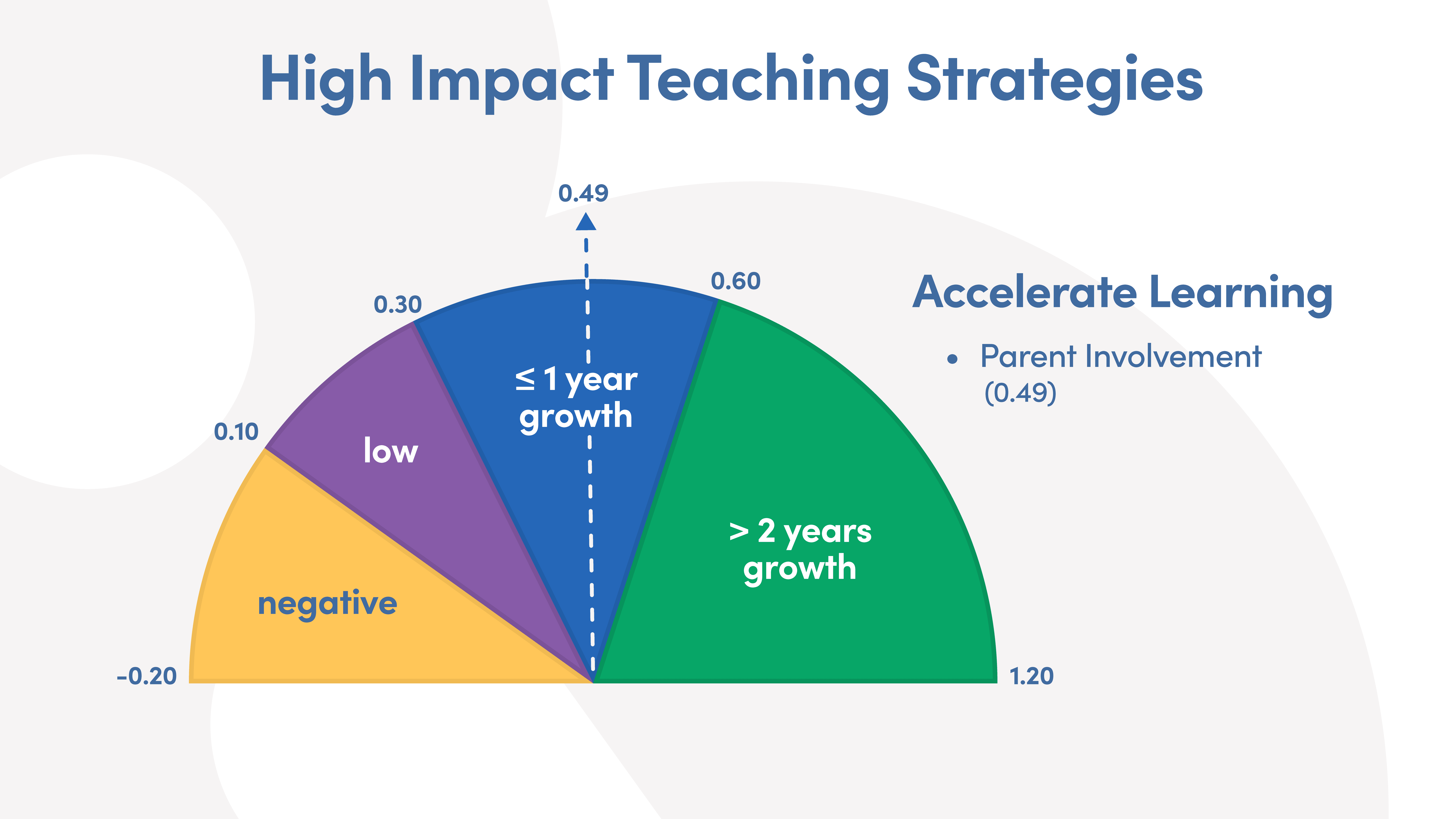
A year’s worth of growth tells us that increased parent involvement is important and foundational for the success of a student’s future. The natural evolution of this school-family relationship changes dramatically from elementary school through high school, and we must acknowledge these dynamics and work to overcome them without becoming resigned to them. There is no ready-made recipe to increase parent involvement in every school, so coming up with what provides transparency and builds perceived value in your school community is where the work (and one might say the opportunity) lies.
Yet, of the six relationships on the pathway towards a future-ready generation, the school-family relationship is the most difficult to influence for all the reasons we discussed above. Fortunately, the research also tells us that parental involvement can be mediated based on the level of belonging that the student feels at school. (Kuperminc et al., 2008) Therefore, if a student has a high sense of belonging at the school, they can still perform at a high level despite the level of parental involvement.
In our next post, we turn to the student–student relationship and explore how belonging, peer influence, and shared learning experiences shape engagement and learning in school.
Meet the Expert

Damon Finazzo, M.Ed. is the Vice President of Learning Research & Design at Big Ideas Learning and is an education leader who has served in a variety of roles over the past 24 years, some of which include elementary school teacher, PreK-8 principal, and president of a PreK-8 Catholic school system.
He holds instructional (K-6) and administrative (N-12) credentials from the Virginia and Pennsylvania Departments of Education, and a Master’s of Education in School Leadership and Supervision (N-12) from Virginia Commonwealth University.
Damon’s experiences in working in PK-12 schools and educational publishing for PK-16 mathematics has proven him to be a collaborative, thoughtful, and compassionate leader focused on teachers, students, and community with an educational philosophy grounded in three fundamental principles: belief, motivation, and service.
References
Kuperminc, G.P., Darnell, A.J., & Alvarez-Jimenez, A. (2008). Parent involvement in the academic adjustmentofLatinomiddleandhighschoolyouth:Teacherexpectationsandschoolbelongingasmediators. Journal of Adolescence, 31, 469–483. doi:10.1016/j.adolescence.2007.09.003
Visible Learning For Mathematics, Grades K-12. Hattie, Fisher, Frey, ©2017 by Corwin.