Teaching Strategies

Damon Finazzo
Vice President of Learning Research & Design
The Student-Student Relationship: How Belonging and Peer Influence Foster Engagement and Learning
Published
Last updated
We already explored the Teacher-to-Student relationship (the first and most important relationship to support student belonging at school) and now we will explore the Student-to-Student relationship, which is the second most important relationship on the pathway towards a future-ready generation.
Research (Josselson, 1992; Deci and Ryan, 2000; Slaten et al., 2016) has taught us that relatedness and belonging are basically synonymous with one another when it comes to understanding students and their education experience. This relatedness to peers is an important factor in student learning. In fact, peer influence is another High Impact Teaching Strategy that accelerates student learning.
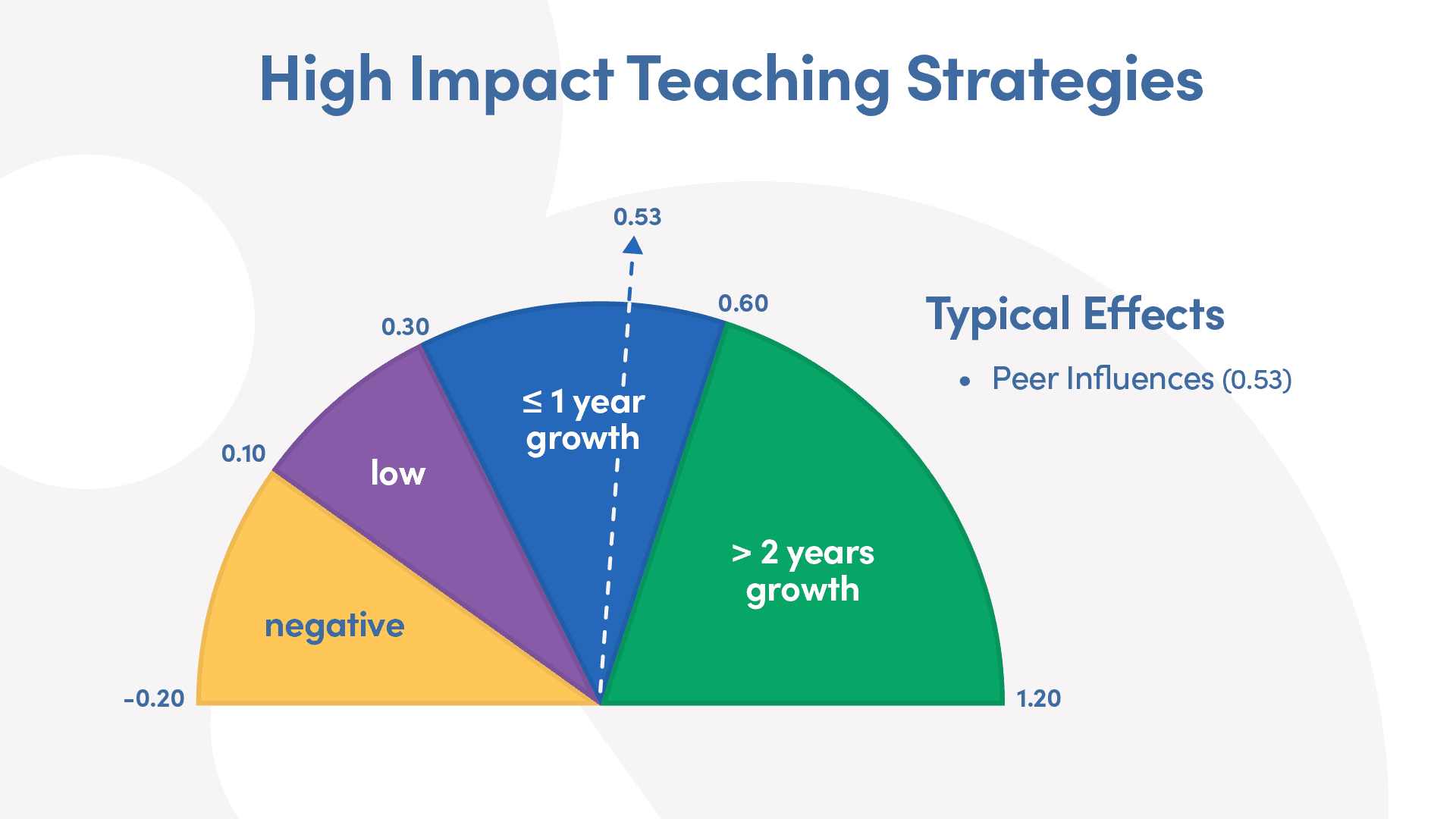
There are so many intricacies in the lives of our students that can make this relationship overwhelming at times, both for the student and the educator. However, with positive peer influences having the ability to support up to one year of learning growth in one school year, it seems worth administrators’ and teachers’ time and attention to consider ways to help students relate to one another.
If we pull back and look at the big picture, there seems to be one aspect of our schools that can enable students to relate to one another positively:
Bringing Students Together through a Focus on Content Learned in the Classroom
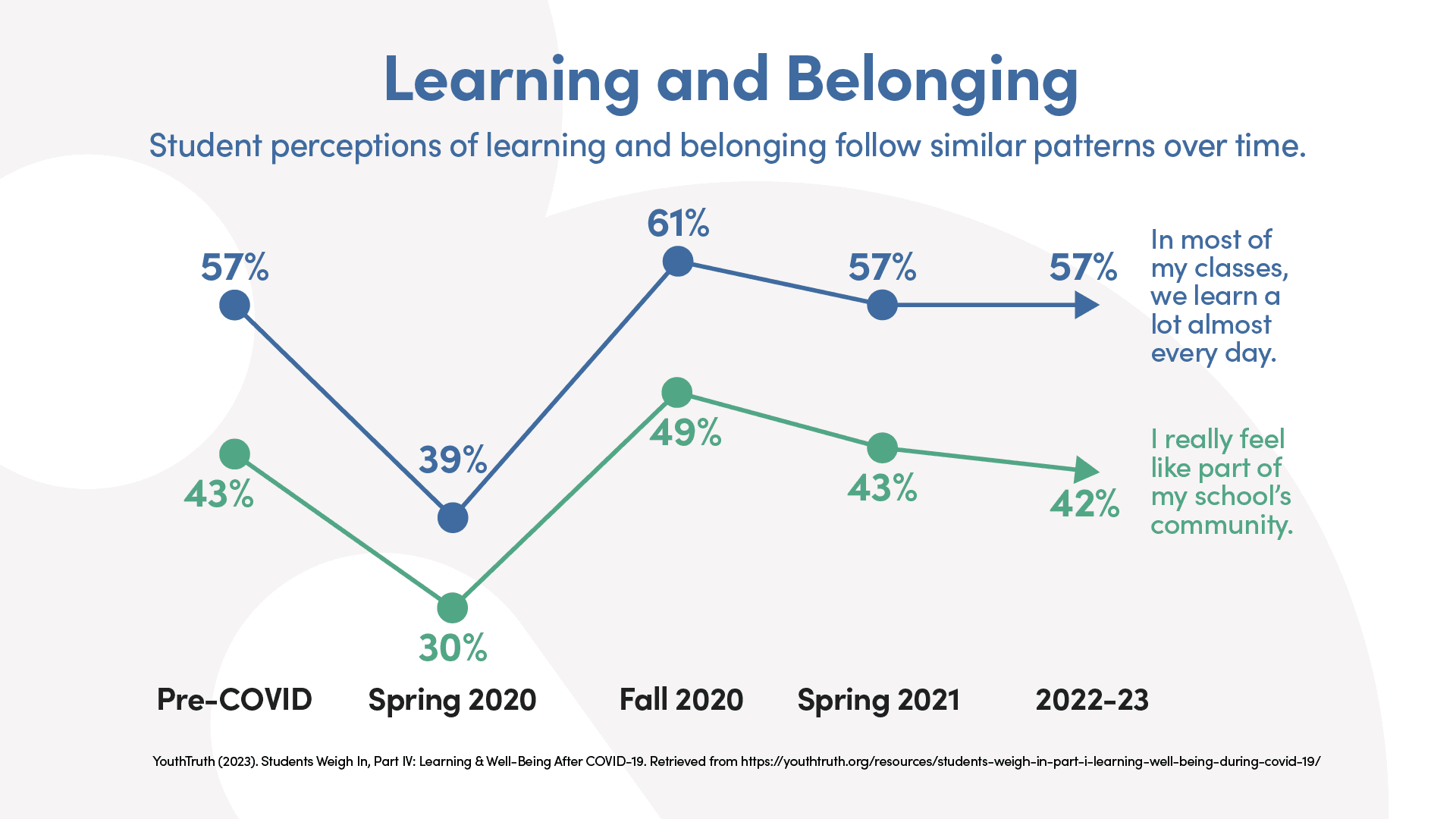
Focusing on the content being learned in the classroom is an obvious, and often times overlooked, way to bring students together. The content is, after all, something that all students in the classroom should have in common. YouthTruth (2023) has gathered some longitudinal data on student perceptions of learning and belonging, and while we cannot establish a causality relationship from these numbers, it is apparent that there is an associative relationship between higher levels of perceived student learning and higher levels of perceived student belonging at school.
When looking at the visual representation of this student data, one might at first think that how the student feels about belonging to the school community is what determines the level of learning the student experiences. However, if you look closer at the data gathered, the clear drop in student learning in the spring of 2020 (as schools were closed down or operating in a very limited academic capacity) seems to be what pushed down the student feeling of belonging to the community. It also seems clear that when schools reopened and the learning was occurring more regularly in student lives, the sense of belonging to the community rose with it, almost immediately.
When the teacher and school establish the proper relationship with the student and the family, they can trust that learning is what should be the focus of the classroom. This trust can help overcome many of the differences that students have from one another, leaving the content in the classroom as the most important aspect remaining to be addressed.
So, what does all of this mean?
The Impact of Positive Peer Influence Amidst the Struggle of Parental Involvement
Higher parental involvement positively affects student engagement in school in many ways:
Less disruptive behavior
Reduced absence
Increased compliance with school rules
However, when parental involvement is less present, positive peer influences can still have positive impacts on student learning (up to approximately 1 year of growth). When students relate well to their peers, they feel like they belong to their school community. Belonging and learning seem to have an associative relationship with one another—where one is strong, the other is also.
To return to the premise I made at the beginning of this post, I would like to consider some practical ways to focus on the academic content in the class that can establish a collective commonality for all students to rally around and relate to. Since every classroom and every grade level has its own dynamics and nuances, I am going to suggest some approaches that should span any grade level and situation enabling any teacher to put their own personality and flare to the ideas, accordingly.
Establish Identity
Take specific time at the beginning of the school year or at the beginning of a course to discuss and brainstorm around what this group of students wants to be known by.
Establish a mini-mission statement as a class or display a list of what someone might see and hear when visiting this classroom at any given time and day. This can be as fun and creative, or as straight forward and simple as you want to make it, yet student learning and student collaboration must remain as the goals in mind behind the identity.
Have the students fully contribute to the how we learn and why we learn in class, which will encourage them to work closer together to uphold the how and why that they all agreed upon.
Display and revisit this identity often throughout the year.
What Does Success Look Like?
To accompany the classroom identity, it is equally important to establish what success looks like for each individual student and class. While we provide math Learning Targets and Success Criteria for every lesson in our program, I suggest taking the concept of success another step forward. If the class identity is what the group of students might generally look like or sound like on any given day, success is what each individual and the whole class should look like, sound like, and perform like for each specific goal, benchmark, or new concept being learned.
Facilitate personal, small group, and whole class exercises in identifying what success looks like for each goal, benchmark, or new concept.
Success can be articulated in writing and/or illustrated appropriately depending on the goal, benchmark, or new concept.
Success articulations should be...
in the students’ voices
clearly understood
collectively agreed upon
small enough to accomplish independently
established as frequently as necessary
...to keep success always visible and realistically achievable for every child and class.
Success articulation examples:
Creative leaning - “I can write and perform a song teaching my peers about the importance of the Order of Operations.”
Straightforward leaning - “I can teach my classmate the importance of the Order of Operations and how to follow them.”
Collectively Celebrate
Foster an environment where the successes of each child, group, and class are celebrated and positively reinforced, while also removing the perception that one student’s success comes at the cost of another student’s failure or loss.
With the students, establish appropriate ways to collectively celebrate success.
Celebrations do not need to cost money, examples such as playing a class favorite song, reserving a special seat in the room, and/or coming up with a cheer to celebrate a success are more than appropriate collective celebrations.
Align the celebrations with the class identity and success articulations
Celebrate often enough that it becomes part of the tradition of the classroom, but not so often that it loses its value and becomes background noise to the day.
Vary Learning Opportunities
Provide different learning and performance opportunities in the classroom that resemble the real world, where individual, small group, and large group efforts are needed to solve problems and find success.
Independent practice and assessments come naturally in classrooms. Balance their frequency with other formative and summative assessments, so students do not only see success when they are working alone.
Utilize strategies like Think-Pair-Share, Partnering, and/or Turn and Talk to support small group learning and collaboration. Work with the students to determine realistic situations where formative assessment opportunities can be completed in pairs and/or small groups.
In collaboration with your students, pick 3-5 opportunities where mid-size to large groups of students can be assigned to work together on a task, problem-set, and/or project. Establish a realistic rubric with your students so the value of the work completed matches the value of the credit and impact on the student’s course grade from these efforts.
Classrooms with an established and maintained collective identity, that understand and can articulate what success looks like, who celebrate these successes appropriately and authentically, and practice real-world collaboration/teamwork are classrooms that have students who have strong relationships with one another and a solid sense of belonging to their school community. These are the same classrooms that overcome outside influences and lower parental involvement, too. Since the research tells us that when students relate to their peers and have a high perception that they are learning new and valuable things, their sense of belonging increases and so does their learning outcomes. When teachers help establish strong student-to-student academic relationships, not only does student learning improve but so does the student’s ability to be future-ready.
In our next post, we’ll turn to the curriculum–student relationship and explore how perception, motivation, and productive disposition shape students’ engagement and learning in mathematics.
Meet the Expert

Damon Finazzo, M.Ed. is the Vice President of Learning Research & Design at Big Ideas Learning and is an education leader who has served in a variety of roles over the past 24 years, some of which include elementary school teacher, PreK-8 principal, and president of a PreK-8 Catholic school system.
He holds instructional (K-6) and administrative (N-12) credentials from the Virginia and Pennsylvania Departments of Education, and a Master’s of Education in School Leadership and Supervision (N-12) from Virginia Commonwealth University.
Damon’s experiences in working in PK-12 schools and educational publishing for PK-16 mathematics has proven him to be a collaborative, thoughtful, and compassionate leader focused on teachers, students, and community with an educational philosophy grounded in three fundamental principles: belief, motivation, and service.
References
Deci,E.L.,&Ryan,R.M.(1985).Thegeneralcausalityorientationsscale:Self-determinationinpersonality. Journal of Research in Personality, 19, 109–134. doi:10.1016/0092-6566(85)90023-6
Slaten, C.D., Elison, Z.M., Lee, J.Y., Yough, M., & Scalise, D. (2016). Belonging on campus: A qualitative inquiry of Asian international students. The Counseling Psychologist, 44, 383–410.
Visible Learning For Mathematics, Grades K-12. Hattie, Fisher, Frey, ©2017 by Corwin.
YouthTruth (2023). Students Weigh In, Part IV: Learning & Well-Being After COVID-19. Retrieved from https://youthtruth.org/resources/students-weigh-in-part-i-learning-well-being-during-covid-19/