Teaching Strategies

Damon Finazzo
Vice President of Learning Research & Design
The Curriculum-Student Relationship: How Perception and Productive Disposition Impact Engagement
Published
Last updated

The final two relationships we will examine are less about direct human-to-human relationships and slightly more abstract, but they are not any less personal and impactful for the student.
In the Curriculum-to-Student relationship, how a student perceives the curriculum directly shapes how much they value what they’re being asked to learn. That sense of value, in turn, determines how effectively the student learns. Let’s look at the research and data that helps underpin these claims.
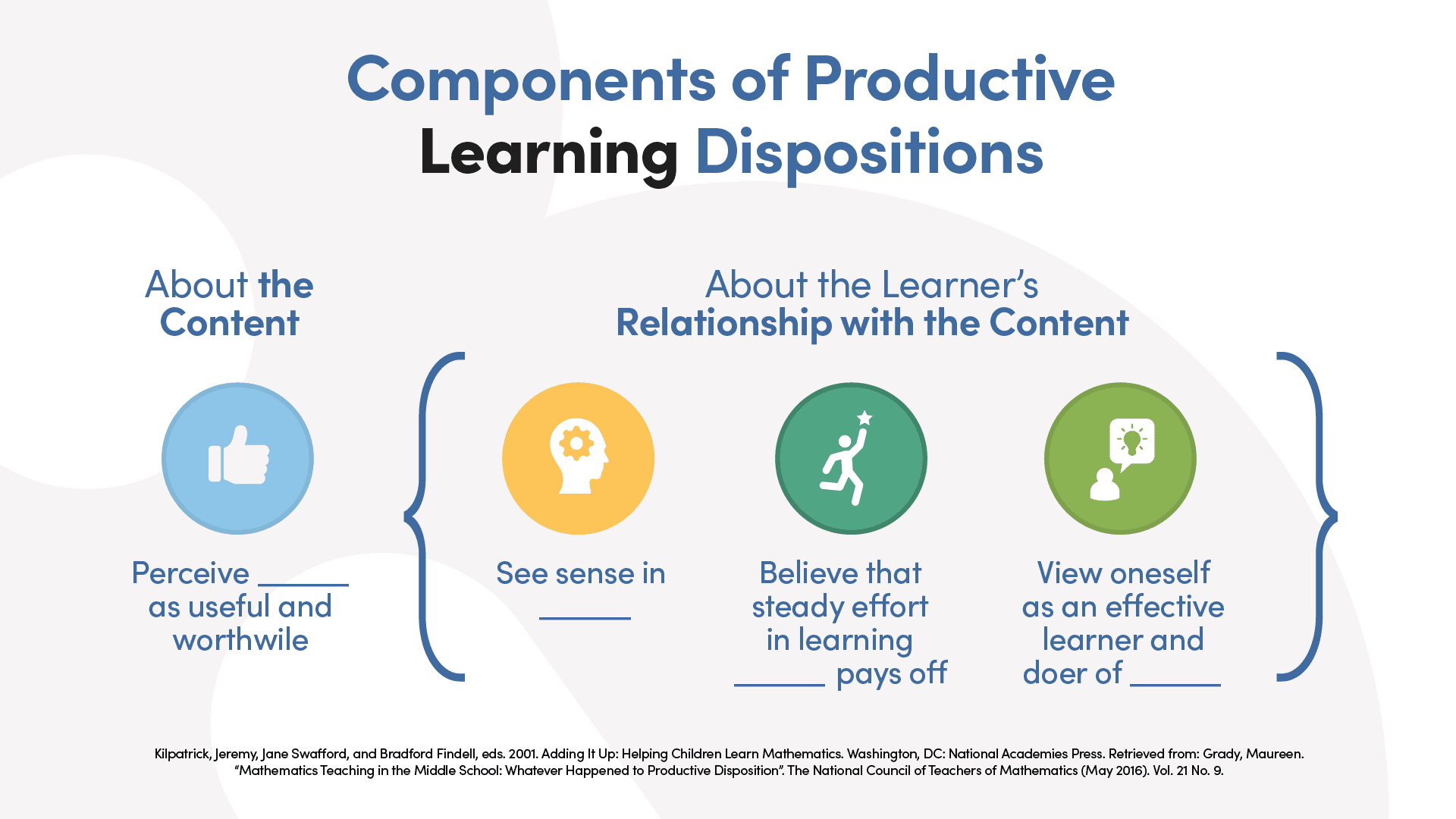
Productive Learning Dispositions help us to dive deeper into this relationship (Kilpatrick, et. al, 2001). The first component (Perceive ‘Math’ as Useful and Worthwhile) is mostly about how the student perceives the content. The other three components (See Sense In ‘Math’; Believe That Steady Effort in Learning ‘Math’ Pays Off; and View Oneself as an Effective Learner and Doer of ‘Math’) are all about the learner’s relationship with the content.
Recent research tells us that middle and high school students perceive math as useful and worthwhile (which is great news), yet they have strong opinions of what they mean by learning math. Regarding the other three components, the research tells us we are not doing as well as we would like.
Student Motivation: Making the Connection to Mathematics Curriculum
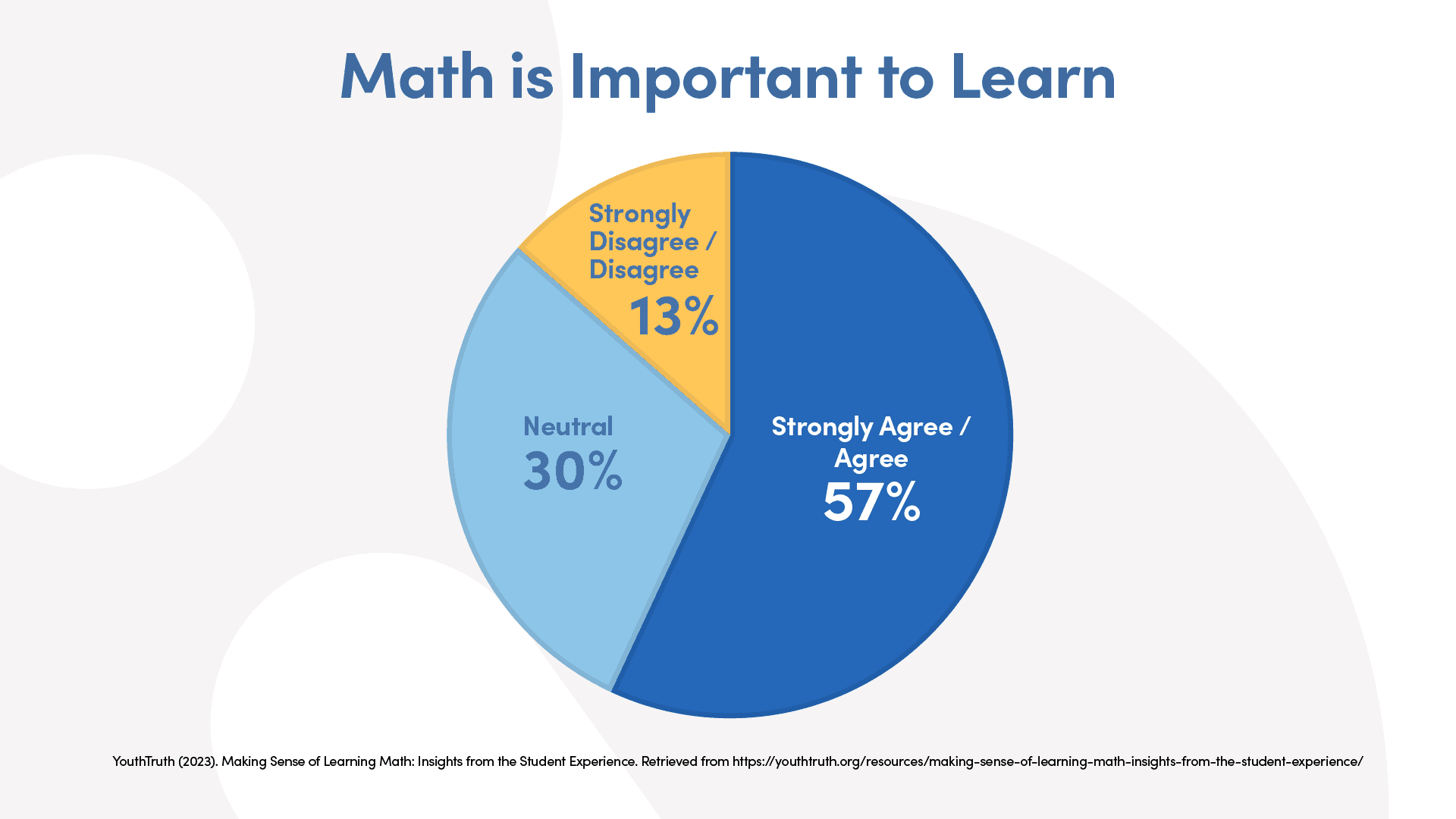
As we can see from YouthTruth survey results (chart below), the majority of high school students agree that math is important to learn and only a small minority disagree. When we look slightly deeper into the results, we see students have strong opinions of the math they are expected to learn as compared to the math they want to learn (Motivation - #56 on High Impact Teaching Strategies list). They see the short-term gain in learning “school math” as more for graduation and college admissions, while concluding that the long-term value of “real math” (wealth and adult independence) is the most useful and worthwhile for them. Again, student perception of math is positive overall.
In looking at students’ relationship with the content, things start to shift the other direction. When asked how often math content is interesting, over half of the students feel the content is either sometimes or rarely interesting. Our obvious goal as math educators should be to try and reverse this sentiment, where most students would feel that math content is often or always interesting.
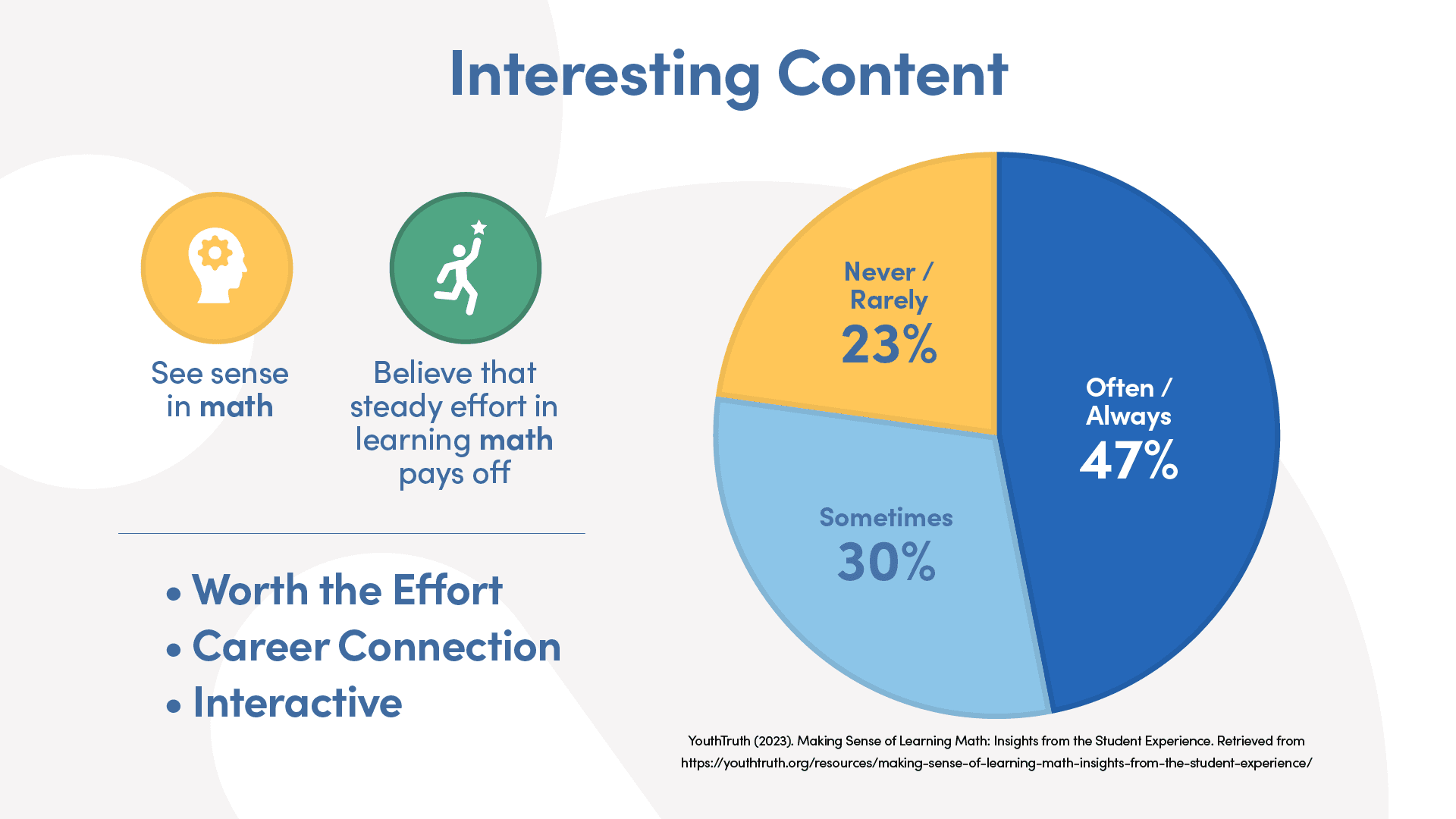
When YouthTruth examined the individual reasons students gave, three themes emerged: the content did not feel worth the effort to fully engage with, it lacked career connection, and it needed to be more interactive. For students to better see the sense in math and to believe that steady effort in learning math pays off in the end, these issues need to be addressed at all levels of education.
When students don’t see the sense in math and don’t feel effort in math eventually pays off, it’s difficult for them to see themselves as capable, effective learners and doers of mathematics. In a study of two hundred 7th grade students, it is evident that most students do not view themselves as mathematicians. (Picker and Berry, 2001)
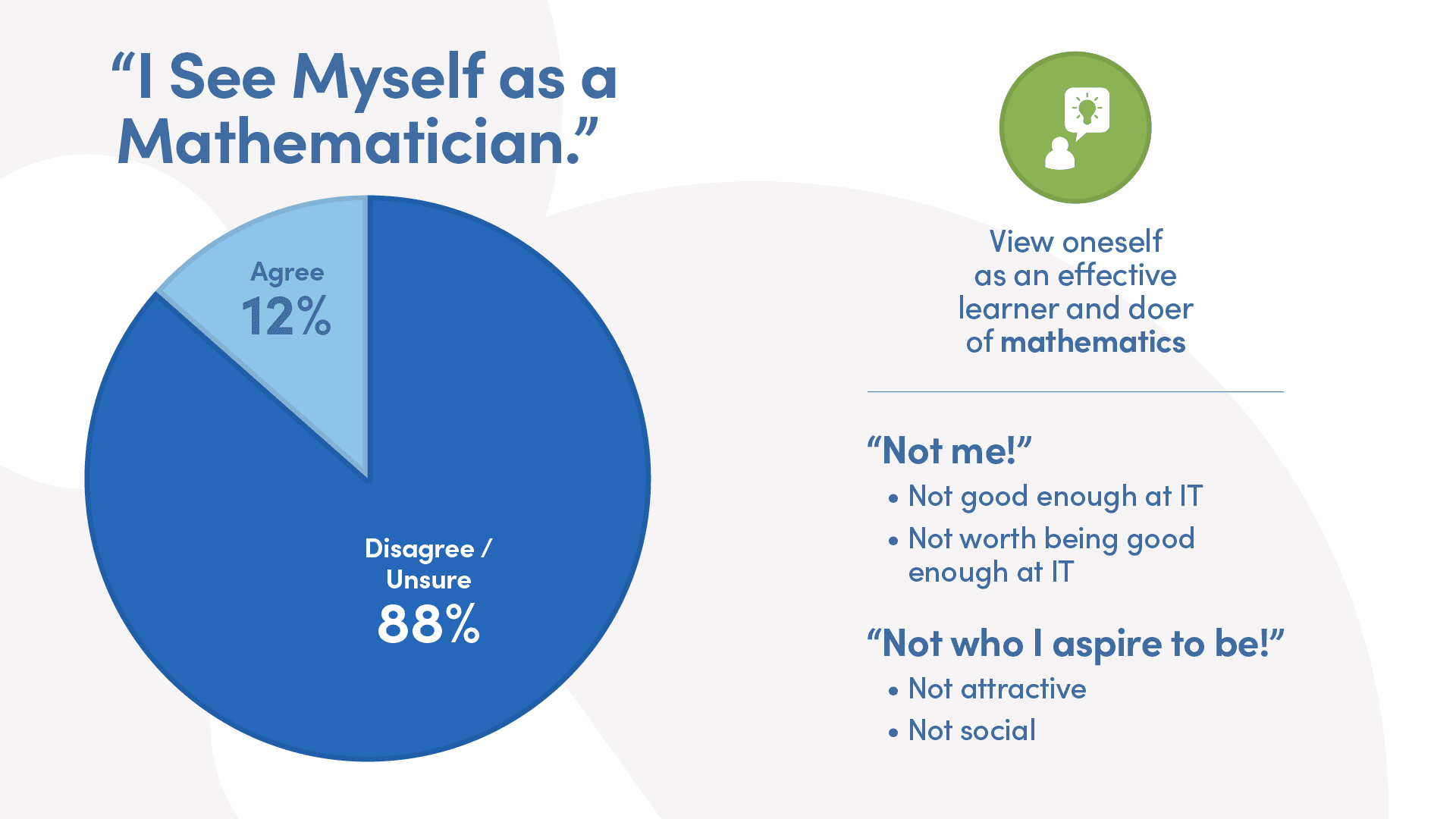
Then who do students see as mathematicians? Unfortunately, students envision a mathematician as someone who is tired, lonely, unkept, and sits at a messy desk all day only thinking about solving hard problems just to get to the next hard problem to solve. Interestingly, in YouthTruth's research, only one student envisioned a female mathematician, and no students envisioned an individual from a racial or ethnic minority, despite all those groups being represented among the students and teachers administering the survey. This highlights the disconnect between the math content and the relationship that students have with the math content.
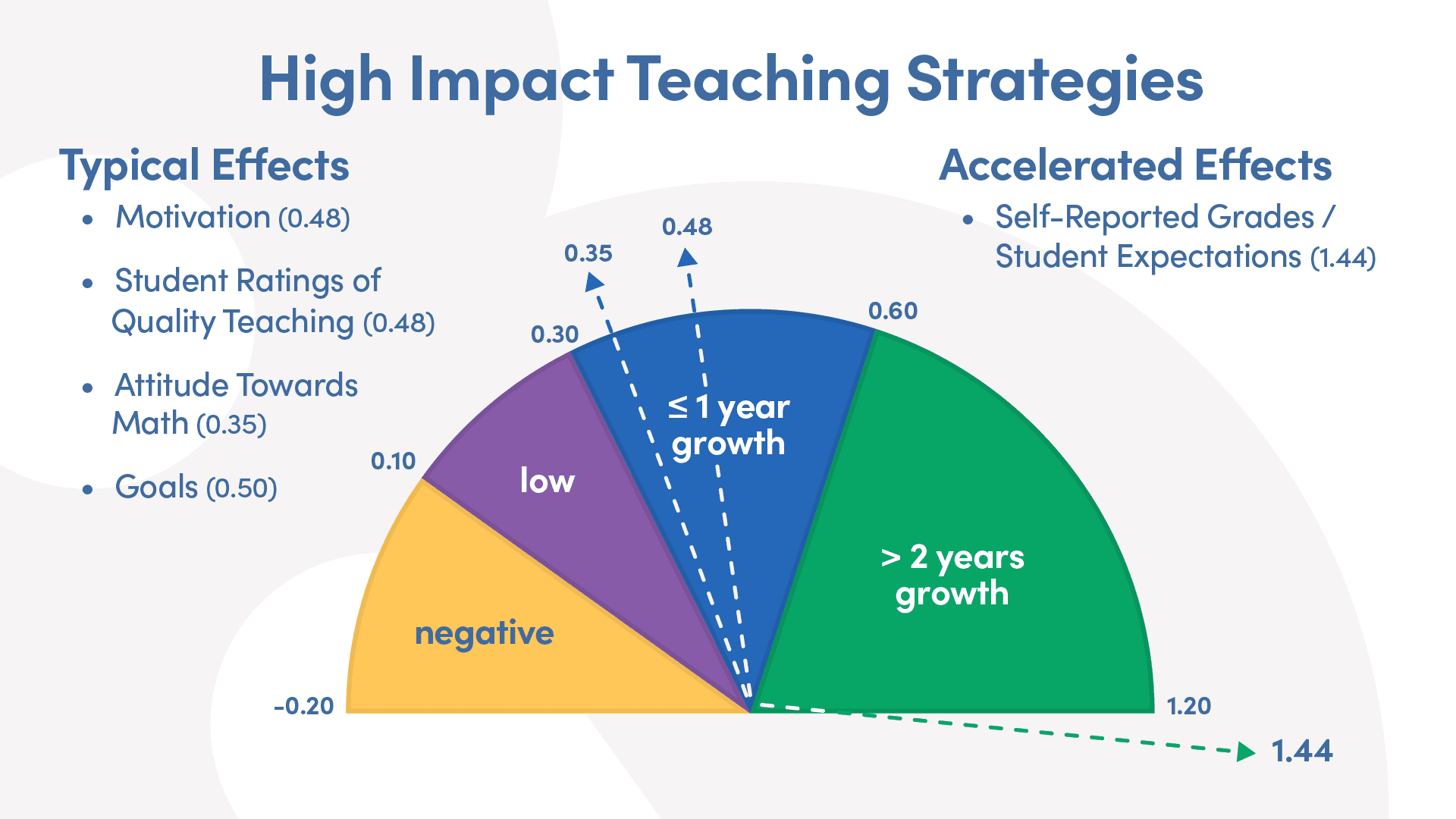
This disconnect is important for us to pay attention to, because attitude towards mathematics also shows up in Hattie’s High Impact Teaching Strategies (#82) indicating positive attitudes towards mathematics can render up to one year worth of growth. While this is not in the highest tier of High Impact Strategies, it remains part of the table stakes necessary for a student to continue learning on grade level, year over year.
Improving Students’ Relationships with Mathematics Content
I propose two classroom strategies that should help improve student relationships with math content: Student Perception Surveys and Self-Reported Grades/Expectations. Our schools have become adept at assessing and testing student performance, yet we don’t seem to ask our students how well they think they know the content. Studies find that when students are surveyed about their learning, it improves their self-perception and their perception of the teaching they receive in the classroom. Teachers can utilize these survey results to predict the learning and achievement gaps of their students. (Gates Foundation, 2012)
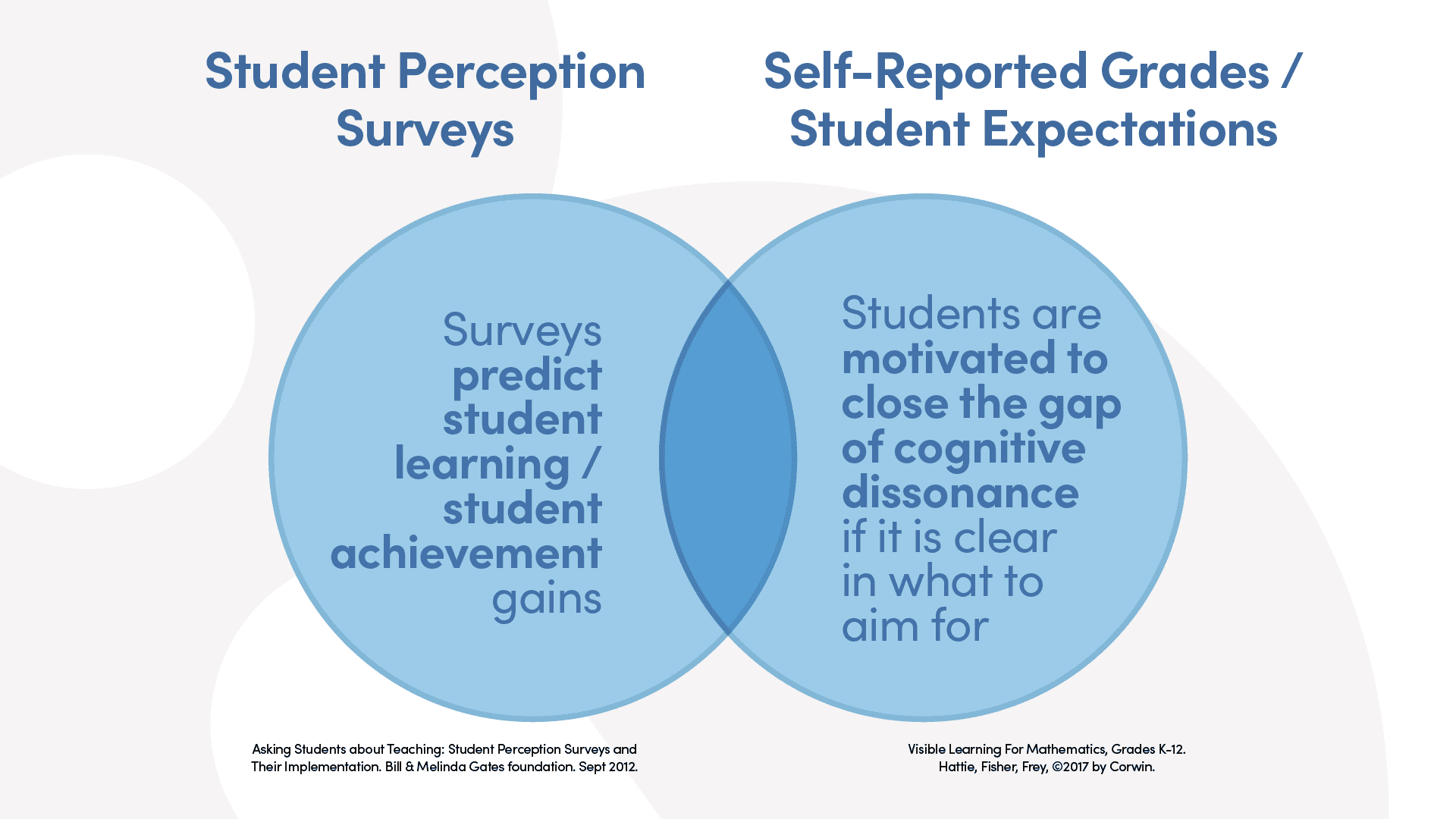
While it is wonderful when a teacher can predict student achievement, it is even more powerful when a student participates in this process. Having students self-report grades and expectations ahead of an assignment, exam, or task enables students to engage in the process in a proactive way. They begin to identify their gap of cognitive dissonance ahead of time which prevents them from being passive receivers of grades and scores on their assignments. (Visible Learning, 2017)
By repositioning the students within the performance evaluation process like this, they become intrinsically motivated to close that gap and become much more attuned to the learning targets and success criteria that help define what success looks like for their learning. Naturally, students will want to set learning goals (per day, week, month, year) and come up with plans for how to accomplish those goals. Carving out class time for students to measure and evaluate their progress against their goals aligns very well with the research, too.
Improving student attitude towards math, motivation, ratings of quality teaching, and goal setting renders one year’s worth of growth. Self-reported grades and student expectations are only out ranked by Collective Teacher Efficacy and can potentially render more than two years of growth in one school year for a student.
The data points in a clear direction: Students already come to school believing that math matters and is a foundation worth building on. The work ahead is helping them see themselves within that picture: as capable, motivated learners whose effort in mathematics connects to real careers, real independence, and a future they can envision. That shift in perception, along with effective classroom strategies, is what the curriculum-to-student relationship makes possible.
In this series we have examined how different connections influence student experience and outcomes across contexts:
The teacher–student relationship, and how opportunity and instruction shape learning
The teacher–teacher relationship, and why collective efficacy drives student achievement
The school–family relationship, and how trust and transparency support student learning
The student–student relationship, and how belonging and peer influence affect engagement
The next and final post in this series turns to the student–community relationship, exploring how relevance, identity, and connections beyond the classroom prepare students for future readiness and long-term impact.
Meet the Expert

Damon Finazzo, M.Ed. is the Vice President of Learning Research & Design at Big Ideas Learning and is an education leader who has served in a variety of roles over the past 24 years, some of which include elementary school teacher, PreK-8 principal, and president of a PreK-8 Catholic school system.
He holds instructional (K-6) and administrative (N-12) credentials from the Virginia and Pennsylvania Departments of Education, and a Master’s of Education in School Leadership and Supervision (N-12) from Virginia Commonwealth University.
Damon’s experiences in working in PK-12 schools and educational publishing for PK-16 mathematics has proven him to be a collaborative, thoughtful, and compassionate leader focused on teachers, students, and community with an educational philosophy grounded in three fundamental principles: belief, motivation, and service.
References
Asking Students about Teaching: Student Perception Surveys and Their Implementation. Bill & Melinda Gates foundation. Sept 2012.
Grady, Maureen. “Mathematics Teaching in the Middle School: Whatever Happened to Productive Disposition”. The National Council of Teachers of Mathematics (May 2016). Vol. 21 No. 9.
Kilpatrick, Jeremy, Jane Swafford, and Bradford Findell, eds. 2001. Adding It Up: Helping Children Learn Mathematics. Washington, DC: National Academies Press. Retrieved from: Grady, Maureen. “Mathematics Teaching in the Middle School: Whatever Happened to Productive Disposition”. The National Council of Teachers of Mathematics (May 2016). Vol. 21 No. 9.
Picker, Susan and Berry, John. “Mathematics Teaching in the Middle School: Your Students’ Images of Mathematicians and Mathematics”. The National Council of Teachers of Mathematics (Dec 2001). Vol. 7 No. 4.
Visible Learning For Mathematics, Grades K-12. Hattie, Fisher, Frey, ©2017 by Corwin.